
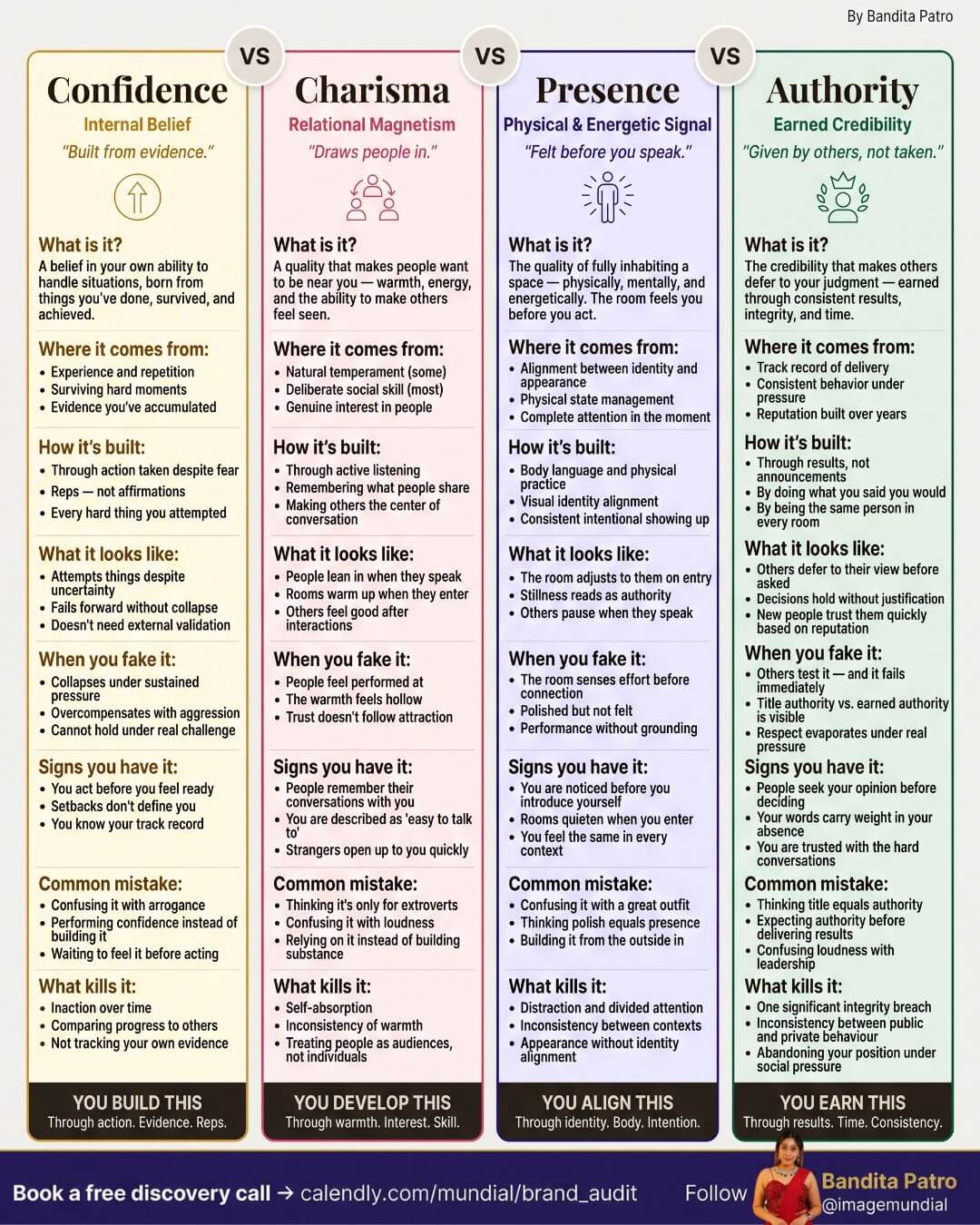
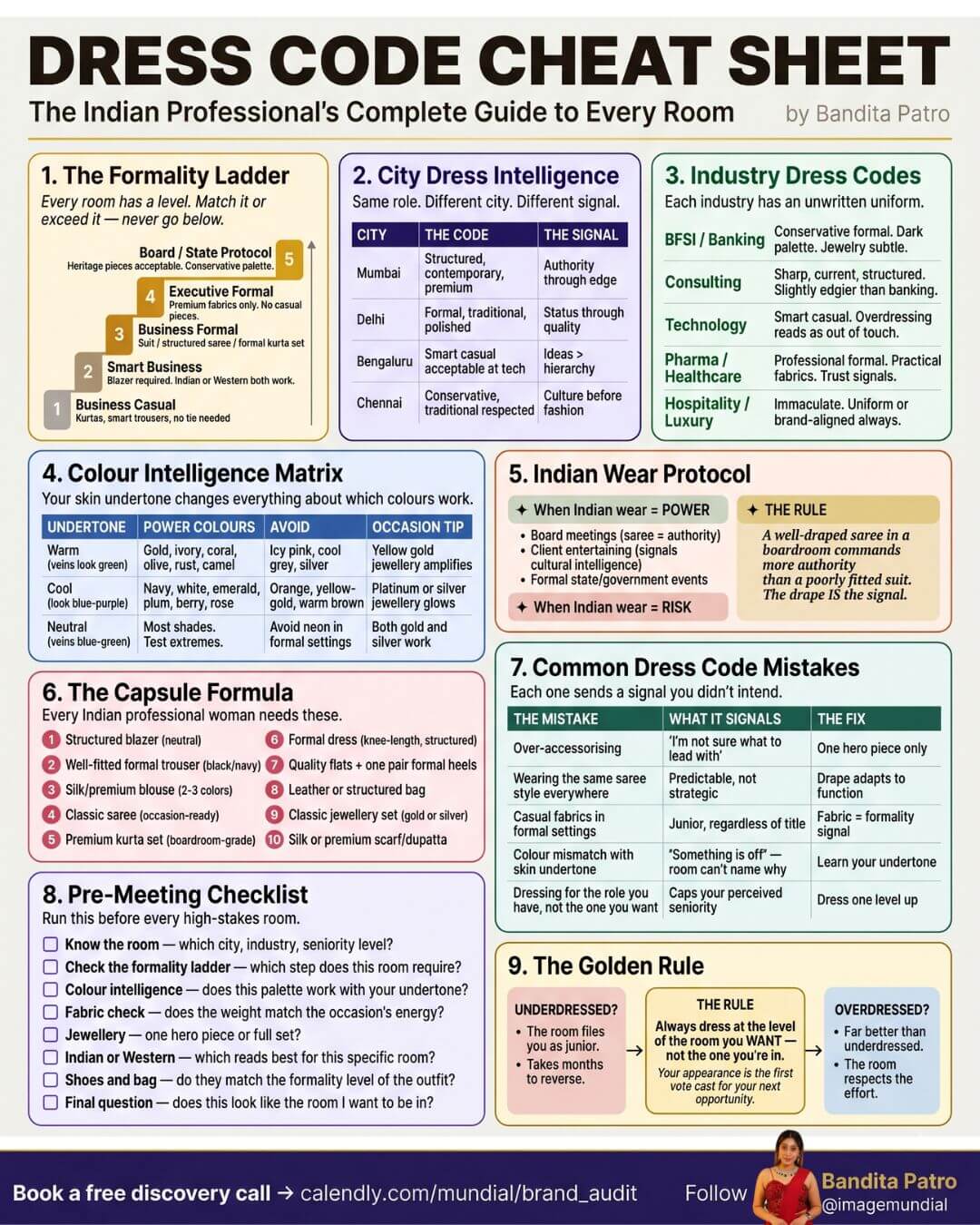
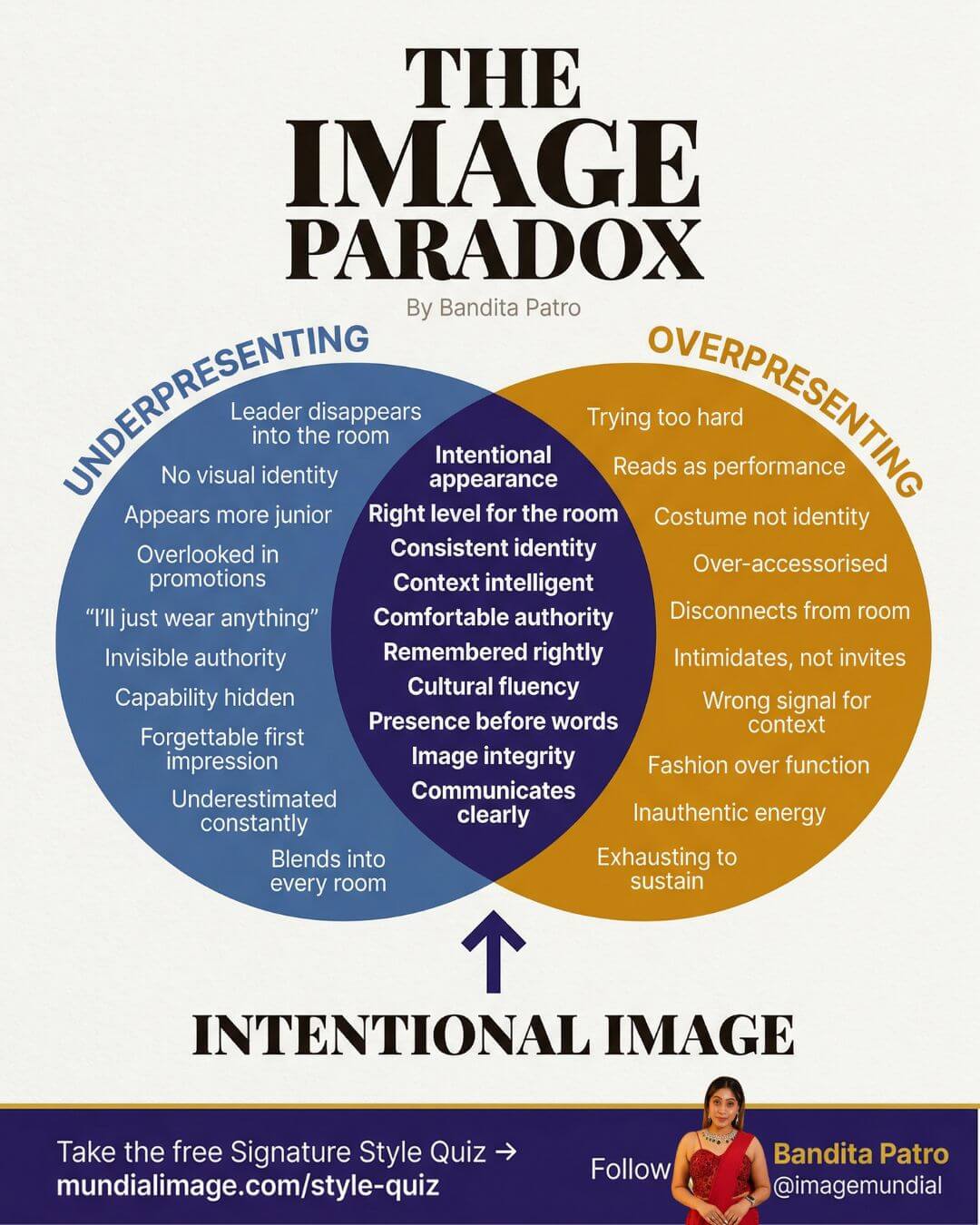
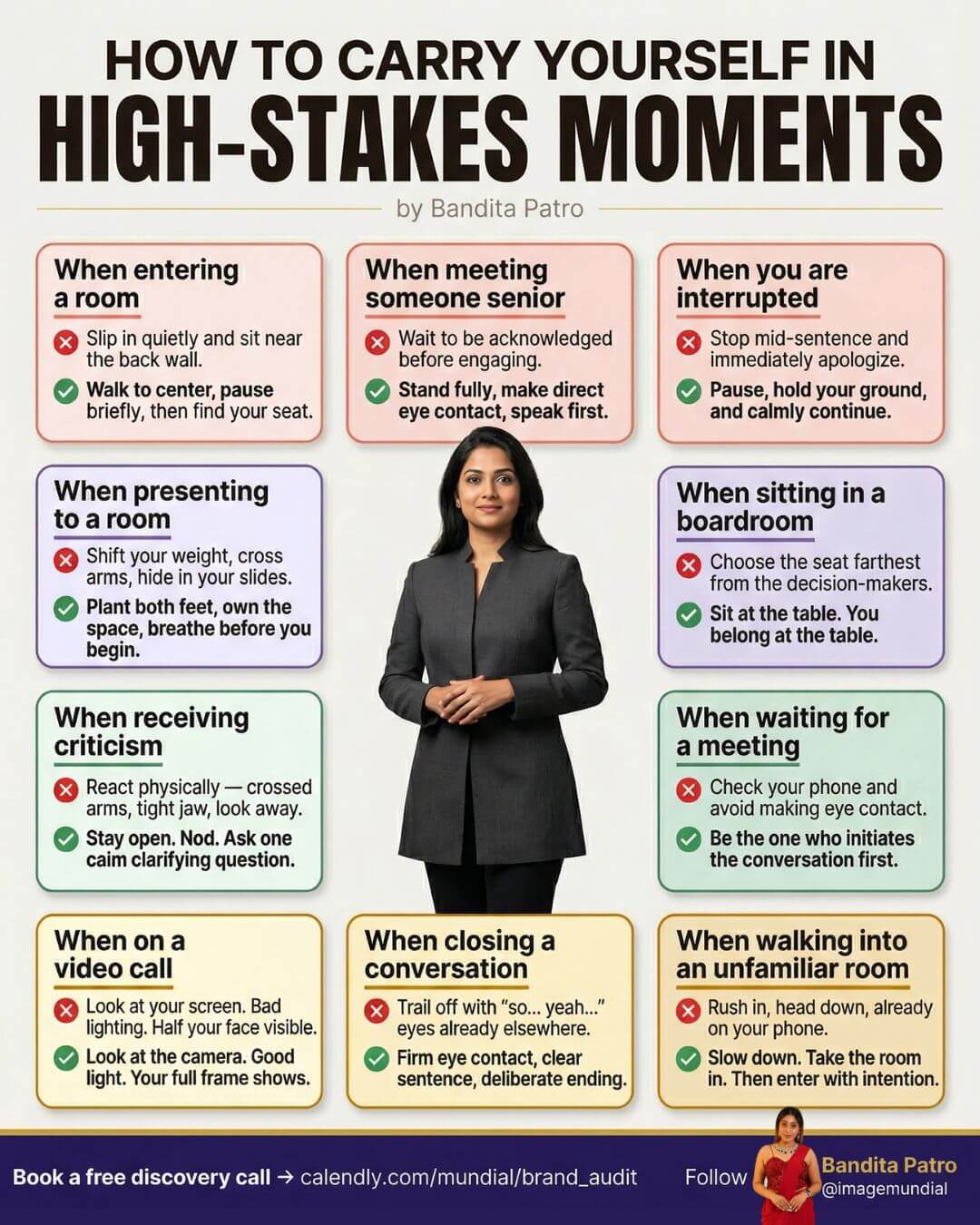
Your image is your visual resumé.
There is a version of you that lives only in other people's heads. It was assembled in the first few seconds of meeting you. I go in and correct it.
One to one with Bandita Patro. Andheri East studio, or online.
The Authority Gap
Nobody gets told to work on their executive presence when these two are level. Closing the distance between them is the work.
There are two versions of your authority.
One you earned and one you project, and your appraisal only measures the first.
Real, and already counted
- What you have delivered
- Who reports to you
- What you have survived
- What would break if you left on Friday
Also counted, just not by anyone who tells you
- Who interrupts you
- Who checks your face when a hard question lands
- Whose name comes up first when a room is being picked
- Who gets asked to present the work you did
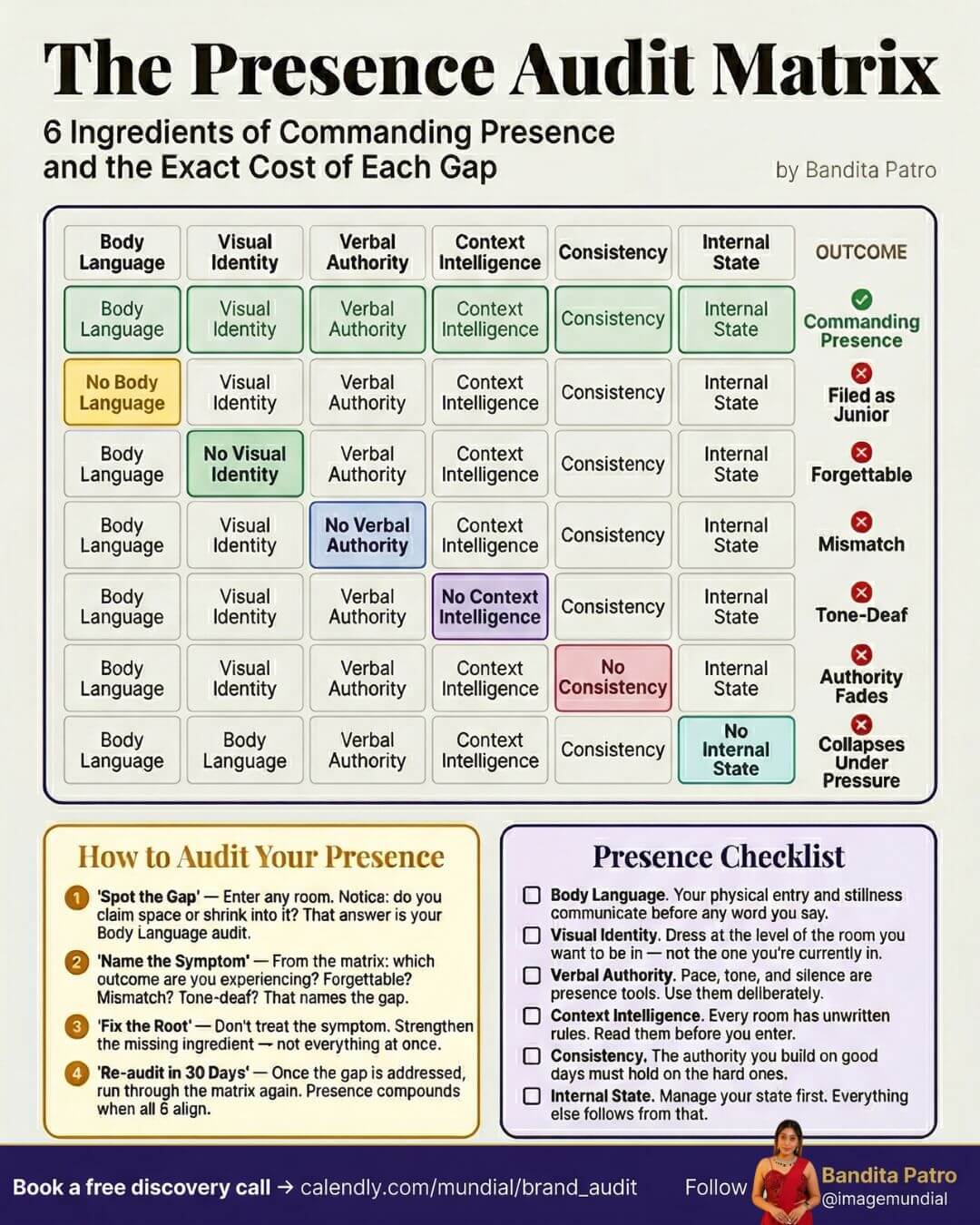
When the second sits below the first, somebody eventually says you should work on your executive presence, and then changes the subject, because there is no next sentence. Usually it is a translation problem, which confidence work does not touch. You are transmitting on a channel the room is not tuned to, and seven of those channels exist.
The framework
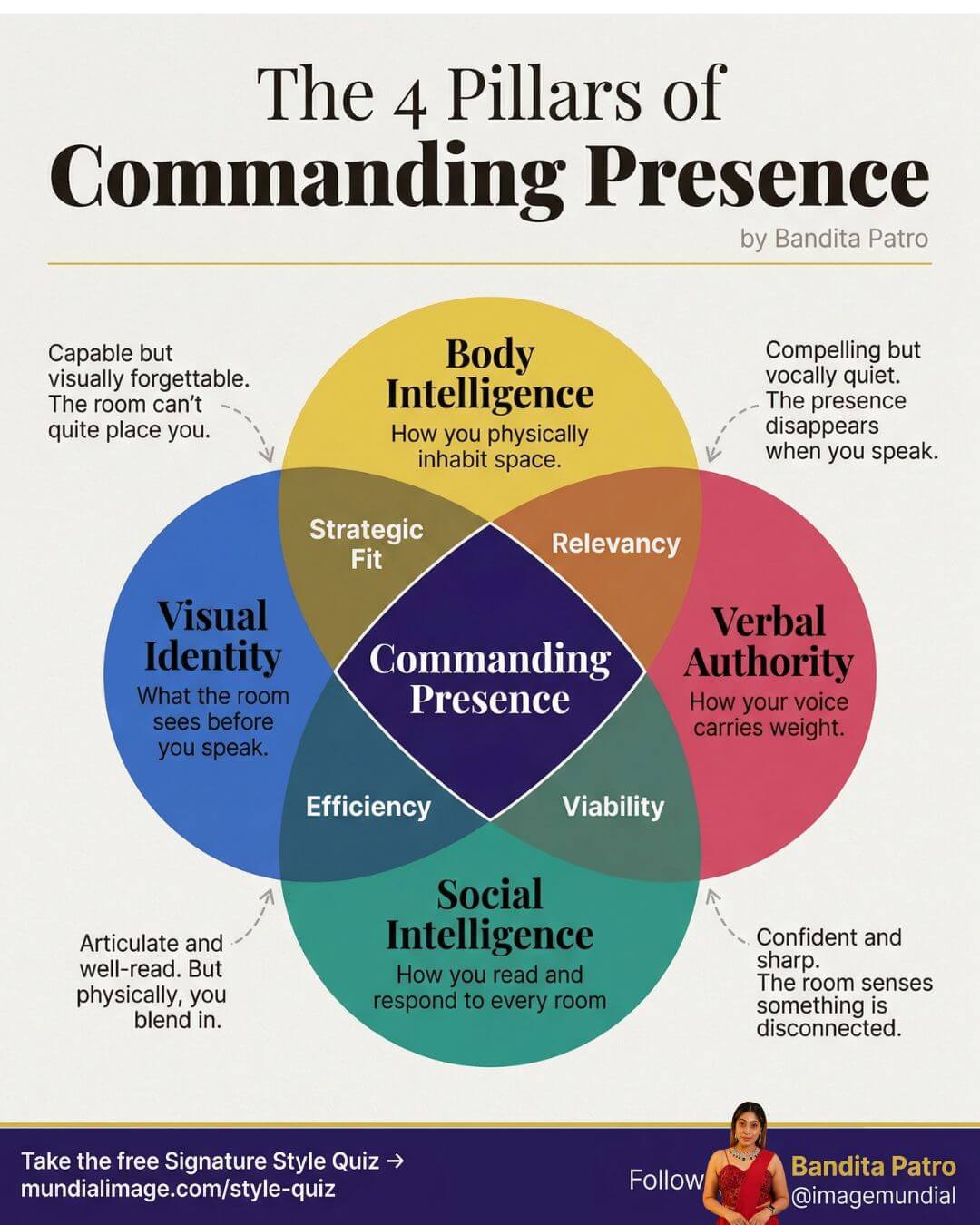
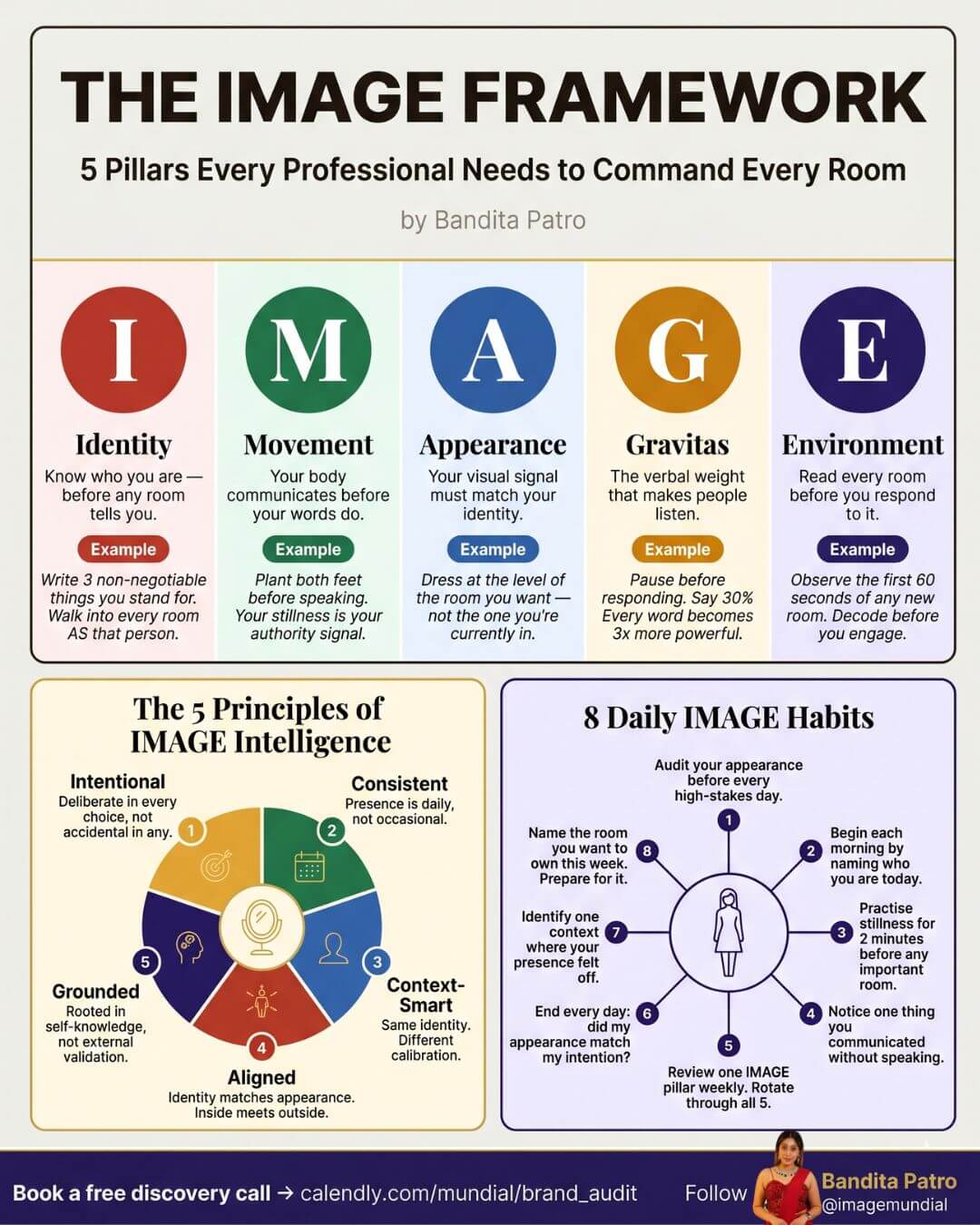
Presence has seven parts. You are over-investing in one of them.
The visual system comes from the Conselle Institute in Utah, where I trained under Judith Rasband. What is mine is twenty years of adapting it for Indian bodies, Indian wardrobes and Indian rooms. Nothing here is held back for the paid version.
Mindset
Self-concept, regulation under pressure, and being clear about what you actually want.
You apologise before you speak. You over-explain a decision you were entitled to make alone.
Where a decade of effort usually goes
What the room takes first
Not a dataset. This is the shape I have watched from the other side of the table for twenty years, and it is why a decade of effort can produce no change. Working on your strongest pillar feels productive. Visual and Physical are usually the two nobody has touched since they were twenty-six.
Two minutes
Score yourself. Be unkind about it.
This is the first thing I do in the studio, and there is no reason you cannot run the short version now. One point for every statement true of you in the last three months. Generous scoring produces a generous diagnosis, and a generous diagnosis fixes nothing.
Nothing is stored, nothing is sent, and there is no email box at the end of this.
0 / 7
Your Authority Gap, short version
Nothing selected yet
Work down the list on the left. Answer for the last three months, not for the version of you that is having a good week.
Notice which statements you scored on. If you scored on 1, 4 and 6 and not on 3, the problem is not the wardrobe. Half the people who come to me for clothes have a Vocal and Physical gap wearing a clothes problem as a disguise.
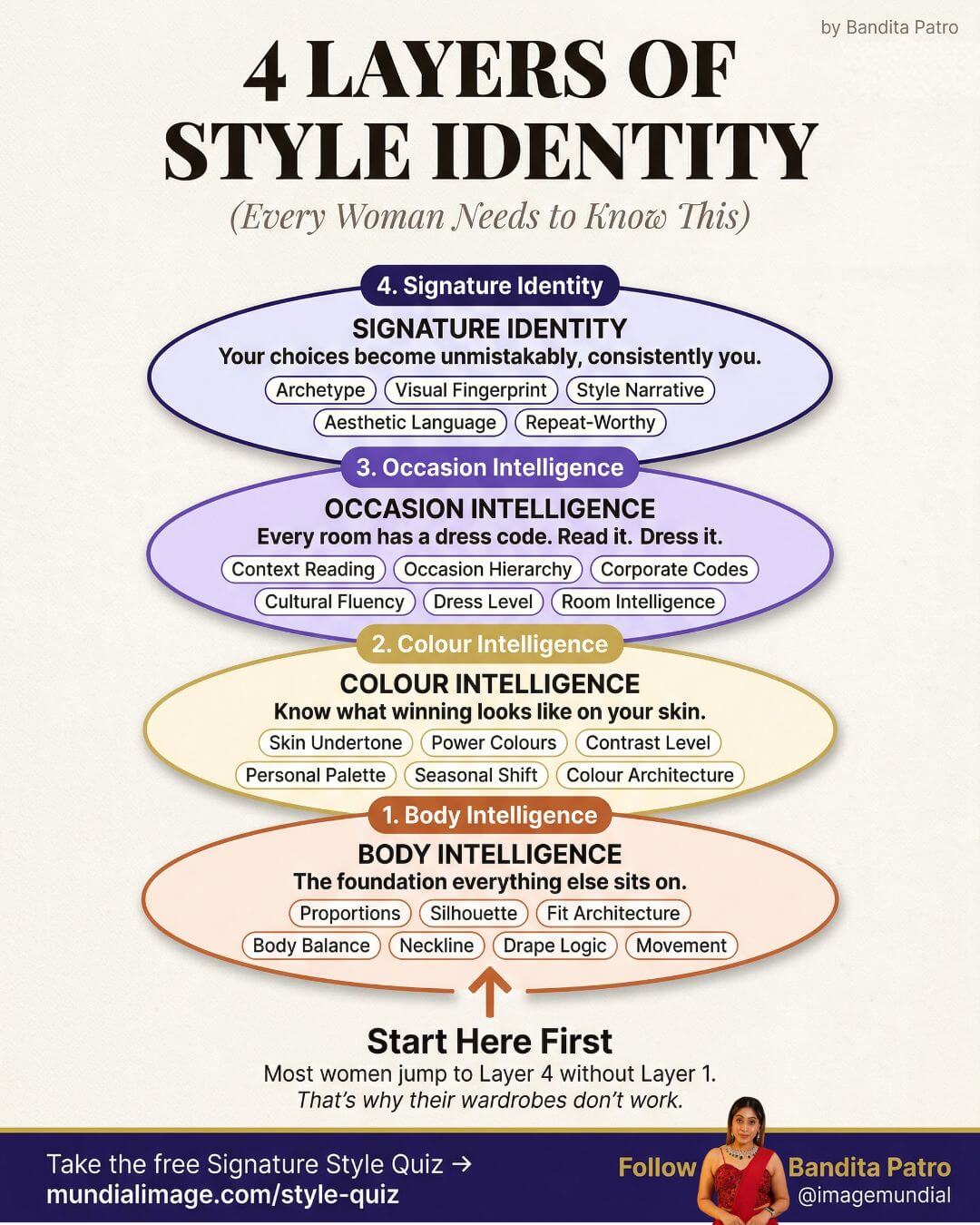
You already have a signature style. You have not named it yet.
Six short films I made for the people who are not ready to book anything. Watch one, and you will know whether the way I think is the way you want to be thought about.
It is in the piece you reach for without thinking. The colour that keeps reappearing on the rail. The way you walk differently in one outfit than in another.
Style gets recognised first, and then made deliberate.
The films play from LinkedIn. Nothing loads until you press play.
Four moves, nine modules, five things you keep.
The order is the hard part. Nine modules run in the wrong sequence give you nine separate opinions. In this sequence each one feeds the next.
Diagnose
All seven scored. Your real calendar, your real rooms, and where those rooms sit on the Style Scale. People want to rush this. It decides everything after it.
- Lifestyle analysis
- Personal style analysis
Design the system
Palette, proportion, face, style level range. Written down rather than remembered, because you will be standing in a shop in eight months without me.
- Colour analysis
- Body shape
- Face shape
Implement
Keep, alter, release. The alter pile is the surprise. Then we shop together, or you give me a brief and a budget and I go without you.
- Wardrobe evaluation and clusters
- Personal shopping
Integrate
The test is whether it still holds in month nine, on a Tuesday, when you are tired. Week two proves very little.
- Lookbook and Room Sheet
- Etiquette and protocol
Five things you keep.
Advice evaporates. These do not, and none of them depends on me.
If closing your Authority Gap required you to keep calling me, I would have built a dependency and sold it to you as a transformation.
The experience
What it is actually like, from the call to month eighteen.
People want to know what happens in the room and are too polite to ask on a first call. So this includes the parts I would rather leave out.
Thirty minutes on a call
You describe the situation. Twenty minutes in I usually know which pillars are involved and I tell you. If it is not a presence problem, I say that instead.
The window
You sit in daylight and I hold fabric under your jaw, one after another. Somewhere in the first ten you will see it yourself before I say anything. Most people go quiet here.
It felt like being handed my own face back.
Shape
Proportions, face, features. Clinical and quick, with no commentary you would not want said out loud. There is nothing you are privately worried about that I have not already seen.
The wardrobe
This one runs long and it can be uncomfortable, because clothes carry things. People have cried over a jacket. That is normal, we take a break, and nothing gets thrown away in the ten minutes after it happens.
Shopping
Against the Shortlist, in order, to your budget. Usually shorter and cheaper than people expect, because the sort has already done most of the work.
What actually changes
Getting dressed stops taking any time. Then the second thing, which is the one you came for. Rooms behave slightly differently. People finish your sentences less.
The compliments stop
By month eighteen nobody mentions it, because the new version is simply what you look like now. It disappoints people slightly when it arrives.
Being unremarkable in the right direction was always the objective.
Roughly fourteen hours of your attention across three to six weeks, and most of it sits on two days.
Most of this is free, and it will stay free.
Read the Blueprint before you spend anything. It gets you most of the way. The last stretch is your body, your colouring, your wardrobe and your calendar, and no document can do that part for you, including mine.
The Executive Presence Blueprint
Eleven chapters. Four open before you give an email.
The whole framework, in sequence, with thirty-seven worksheets you can copy in one tap. Read the first four and decide for yourself whether the other seven are worth an email address.
Open the BlueprintFree · 11 chapters · 37 worksheets
Tap any frame to open it full size. Five new ones go into the library every month, and the Signature Style Quiz takes about four minutes if you would rather start there. Take the quiz
Three reasons not to book this.
You are not choosing between me and nothing. If one of these is you, take the other option and I will not chase you about it.
You want a shopping companion
Personal shopping here sits inside a system. If you want someone to come to Palladium and have opinions, that is a real and enjoyable service, and I am poor value for money at it.
You want to be told you are already fine
The wardrobe evaluation involves hearing that things you paid for are not working. Some people book it and then defend every piece in the room. I would rather lose the booking.
You want a different person at the end
If the result does not look like you, you will not wear it past March, and I will have taken your money to build a costume. This works when it is you with the volume corrected.
Do I have to buy a whole new wardrobe?
How is this different from an executive coach?
Do I have to be in Mumbai?
What if I disagree with your recommendations?
Will I end up looking like everyone else?
Can my company pay for this?
Thirty minutes, and a straight answer.
The call is a diagnosis. Bring the situation and the score you got above. If it is a presence problem I will tell you which pillars and roughly what closing it costs. If it is not, I will tell you that too, and it happens more often than you would expect from someone who is paid to find presence problems.
No cost, and no wardrobe photographs required. You will do most of the talking, so bring the room that keeps going wrong.